| Book: Christine Falls [2006] |
 Christine Falls
by Benjamin Black

When the Booker-Prize-winning, seriously literary Irish writer John Banville came out with this mystery novel in 2006, under a new pen name—and declared it would be the first in a series, no less—critics seemed to appreciate the idea and rewarded Banville/Black with praise for writing a kind of literary-mystery hybrid. In the end, the book succeeds as neither. While it contains many well-written scenes, and is certainly oozing with 1950’s atmosphere, it’s all in the service of a slow-moving and unrewarding plot. One chief problem is that the protagonist, a Dublin pathologist named Quirke, is an obstinately unpleasant character to play the lead in a mystery series: a bloated, chain-smoking alcoholic sloth who has nothing serious or interesting to say about any of the events that take place. (For some reason, and absurdly, Banville has nearly every female character in the novel fall for him, more than one directly into bed for drearily described bouts of sex.) Secondly, the plotting can be mind-numbingly slow. Quirke is consistently told to lay off his investigation into the death of the title character, if he knows what’s good for him, even though it’s not clear exactly what he’s doing or asking that would ever bring him any closer to discovering anyone’s secrets before drinking himself into forgetfulness. When the action comes—and there’s action, in the form of murder, rape, and multiple levels of revealed identities—it’s all presented in the same beautiful but turgid prose. And if you haven’t figured out the central mystery and motives, as well as the main culprit, well before the end of the book, perhaps it’s because the characters have put you to sleep. - Gilligan Labels: Books
|
|
|
|
| Book: What Is The What [2006] |
What Is The What 
by Uzodinma Iweala 
Sometimes, good fiction, like a good Hollywood film, can do more than a thousand textbooks to drive home and personalize an issue in the headlines. In recent times, “African” movies like Hotel Rwanda and Blood Diamond have popularized the general—genocide, the diamond trade, child soldiers—by dramatizing the particular—a brave man’s attempt to reunite with his family, say. In the same spirit, some recent novels have tried to engage a wider readership in issues affecting the African continent. Although the great novel of Darfur has yet to be written, in the meantime there is Dave Eggers’s What Is The What, a novelization, based on interviews and told in the first person, of the life of Sudanese refugee Valentino Achak Deng. The problems and politics of the Sudan are sketched slowly into the life of the book, until the accumulation of detail over its nearly 500 pages has you invested not only in the fate of its main character, but in the current state of affairs for his countrymen in Sudan, as well. You find yourself leaping to find the websites listed at the back of the book to find a way to explore—and if possible, to help ease—the suffering of those you’ve just finished reading about. The book is heartbreaking, uplifting, and ready-made for, well, a Hollywood feature. - Gilligan Labels: Books
|
|
|
|
| Book: American Gods [2001] |
American Gods  by Neil Gaiman
Generally, I’m no fan of fantasy genre novels. And certainly, you’d have to pay me great sums to suffer through even a single one of their bastard cousins, those religious-themed “adventures” by the likes of Tim LaHaye. So how come I loved this book, which mixes the supernatural, the mystical, and more gods than you’d find carved on a collection of Babylonian tablets? In fashioning his traditional quest tale—the main character, Shadow, is drawn unwillingly into a battle of deities for the soul of a continent—Gaiman not only keeps a straight face, he builds a story that is thoroughly grounded in reality while still insisting that the conflict is of epic dimensions. He gives the gods equal weight to his human characters, fits them comfortably together against a landscape of small towns, highways, and tourist traps, and expects you’ll follow him as far as the premise allows. The result is something like a cross between J.R.R. Tolkien and Hunter S. Thompson, with incidents and characters coming one after another, sometimes in ways that border on the hallucinatory, but never losing their essential grounding in reality, until you find yourself at the climax rooting for the heroes and cursing the villains and taking it all seriously. It’s an impressive accomplishment, and one of the first American popular classics of the new century. - GilliganLabels: Books
|
|
|
|
| Book: Warlock [1958] |
 Warlock 

Last week saw the passing of a true Western writer, Oakley Hall. He was a Western writer in the widest sense, a resident and lover of California, who used the genre’s ideas of violence and conquest and discovery to create his fiction. He wrote in different styles and genres, including a nice series of historical detective stories featuring the real-life satirist Ambrose Bierce as their hero. However, his reputation as a serious novelist of Western fiction rests mainly on this ambitious novel, which re-tells a true story already told so many times it has taken on the status of myth: The shootout at the OK Corral. In this fictionalized version, Tombstone, Arizona becomes a town called Warlock, and all roads lead to the climax at the Acme Corral. Along the way, the old Western set pieces are all on display: the principled conscience of a strong sheriff versus the corrupt lawlessness of a band of outlaws; the love of a fiery woman; scenes that reveal strength and cowardice in unlikely places. The whole is weaker than the sum of its parts; the book drags more than a little in spots. But the basic idea—how quickly a society’s civilized veneer can be torn due to the darkness, or weakness, of human nature—had a special relevance in the McCarthy era that has not faded at all over the years. - Gilligan Labels: Books
|
|
|
|
| Book: The Reluctant Fundamentalist [2007] |
The Reluctant Fundamentalist
by Mohsin Hamid
This novel falls with a thump into the category called “post-September-11th” books, and it is not subtle in what it tries to do. There is cleverness and skill in the form, an extended first-person monologue delivered by a Pakistani man, Changez, who has come across an American in Lahore and seems desperate to tell his story to the stranger, over one long evening: Changez came to the U.S. as a modest but ambitious teenager to attend Princeton University, and proceeded to live a kind of immigrant dream. He graduates at the top of his class and is hired by an exclusive, high-paying financial evaluation firm, which prizes his ability to “focus on the fundamentals.” His gradual disillusionment with that job is just one small theme referenced by the title of the book; his growing disillusionment with the United States itself gives the words “reluctant fundamentalist” a teasing edge that adds to the tension in the second half of the novel. Did refined, Americanized Changez, who can't quite say why he found himself smiling at the television image of the World Trade Center towers tumbling down, eventually become some kind of Islamic fundamentalist in Pakistan? A terrorist?
That rather sudden transition—the September attacks come at the midpoint of the book—from a man in love with both New York and a troubled, wealthy young American woman he has met, to the cynical ranter he reveals himself to be as the book progresses, is unnaturally sudden. And Hamid seems to feel that the criticisms Changez lodges against the United States are more shocking than they are. (Who hasn’t wanted to see American ambition knocked down a few satisfying pegs?) A larger failure in Hamid’s argument is that, despite the title, there is almost no mention of religion, which is truly at the center of most of the debates and events Changez seems so breezily judgmental about. That said, the book doesn’t fail to stir the issues in the reader’s mind, and more to the point, the ending of this short, swift novel is sound and satisfying. - GilliganLabels: Books
|
|
|
|
| Book: Cat's Cradle [1963] |
Cat's Cradle
by Kurt Vonnegut
Go ahead and argue about your favorite novel by the late, great Kurt Vonnegut. (I vote for Breakfast of Champions.) But surely one that’s relevant once again is this funny and fatalistic mix of science and theology gone mad. Oh, and it’s also about dictatorships. And Hiroshima, the Nobel Prize, Hoosiers, calypso, Bokonism, love, draft-dodging, art, life, death, nature, humanity, philanthropists and military men, presidents, midgets, bicycle factories, ice-nine, and the end of the world. - GilliganLabels: Books
|
|
|
|
| Book: Don’t Point That Thing at Me [1972] |
Don’t Point That Thing at Me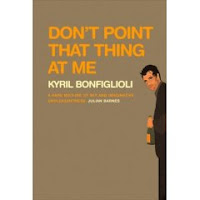
by Kyril Bonfiglioli
Looking for a swift, light mystery novel featuring an alcohol-soaked, insufferably snobbish English art dealer? I didn’t think so. But pick up this recently reissued, overlooked classic featuring Charlie Mortdecai, and then thank me profusely. The mystery through which Charlie stumbles—involving art and international spies and jumps from England to the US and back—is merely an excuse to enjoy Charlie the character, a kind of love child of Bertie Wooster and Jeffrey “The Dude” Lebowski. He somehow manages to get the girls and win the fights, all the while maintaining an impeccably unruffled tone and coming off as innocent of anything other than a desire to find his next glass of Scotch. Almost incidentally, the book takes a bitter turn near the end, and a nearly perfect ending it is, too. So perfect it just about makes you sorry—but not quite—that there are actually three Mortdecai novels, leaving you two more to enjoy later. - GilliganLabels: Books
|
|
|
|
| Book: The Perks Of Being A Wallflower [1999] |
The Perks Of Being A Wallflower
by Stephen Chbosky
This is a book about high school, and friendship, and books, and mixed tapes, and parties, and love and sex. It’s disguised as a young adult novel, but Charlie, who narrates the book as a series of letters which put the reader in the role of confidant (“Dear Friend,” begins each chapter), stands firmly in the tradition of Holden Caulfield, still raging against the phonies, as Chbosky makes explicit in more than one of the many literary/musical/cultural references strewn around the book. The novel rests entirely on the narrative voice of Charlie—awkward, shy, open, way emotional, opinionated (whether you nod in agreement or clench your teeth in frustration at his musical taste will say a lot about your relationship to this book), funny, warm, confused, and unexpectedly moving. The target of prurient book banners and the focus of obsessive cult fans, Wallflower, like Catcher in the Rye, will be exactly the right novel at exactly the right moment for many teenagers, and more than a few adults. - GilliganLabels: Books
|
|
|
|
| Book: House Of Leaves [2000] |
House of Leaves
by Mark Z. Danielewski
To properly represent this massive, odd, aggravating, stunning riddle of a book, it would be necessary to print the words sideways, upside down, inside out, piled on top of each other, in margins, footnoted, illustrated, colliding, sometimes to add layers of meaning, sometimes merely to confuse, almost always to intriguing effect. Instead, first of all, it can be said there are two main plots that interweave here: Will Navidson and his partner Karen Green explore their new house, which turns out to contain an anomaly of space, which leads to more explorations, deeper and deeper into a mysterious and chilling blackness; Johnny Truant comments on the manuscript we are reading, which we are led to believe was left behind by a man named Zampanò, and Johnny’s footnotes and comments intrude further and further into the tale—sometimes taking over many pages—with a chemical-fueled tale of their own. But the main figure in the book remains Danielewski himself, simultaneously sending up critical theories, trying out some outrageous idea every few pages, driving the typesetter crazy with new ways to present the text on the page, and yes, sometimes merely showing off, but ultimately writing a novel that is haunting in a very real, traditional way, a novel about guilt and fear, about knowing and not knowing, and the obsessions that can result when the two collide. - Gilligan
Labels: Books
|
|
|
|
|
|


